Madrid and its surroundings have some of the high quality gardens associated with a capital city. The historic gardens date from the Golden Age (approx 1550-1650) when Spain was the richest country in Europe. Madrid is very cold in winter and very hot in summer, making spring the best time for garden visiting - Parque del Buen Retiro, Museo de Sorolla, Madrid Botanical Garden, Jardin del Palacio de Aranjuez, Jardin del Monasterio de El Escorial.
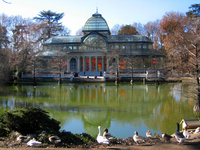 Parque del Buen Retiro
Parque del Buen Retiro »
Once a renaissance garden and the centre of the Habsburg court in Spain, Buen Retiro has become a great public park. The gardens were neglected after the death of Philip IV in 1665 but have been restored and changed on many occasions, notably after being opened to the public in 1767 and becoming the property of the municipality in 1868.
Read more on Parque del Buen Retiro
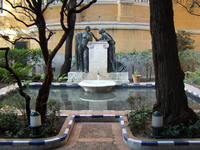 Museo de Sorolla, Madrid
Museo de Sorolla, Madrid »
The studio garden of Joaquin Sorolla Bastida (1863-1923), a post-impressionist painter. It is a courtyard garden, fresh and cool, with water features, ceramic tiles, pot plants and evergreens.
Read more on Museo de Sorolla, Madrid
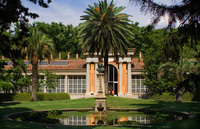 Madrid Botanical Garden (Real Jardin Botanico)
Madrid Botanical Garden (Real Jardin Botanico) »
Situated on the banks of the River Manzanares, the garden began as the King's (Fernando VI) botanical collection in the eighteenth century, when botany was a royal hobby. The plant collection began with a collection of 10,000 plants brought to Spain by Alessandro Malaspine in 1794. A central axis leads from the king's gate to Villaneueva's pavilion. There are three terraces, stepping towards the river from the pavilion. The upper terrace, added in 1859 has a typical nineteenth century character. The lower terraces resemble parterres but are planted with a wide range of
plants. In 1981, it was re-opened with its role more as a public garden than a scientific collection. An entrance charge is .....
Read more on Madrid Botanical Garden (Real Jardin Botanico)
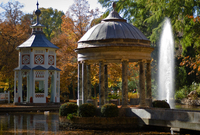 Jardin del Palacio de Aranjuez
Jardin del Palacio de Aranjuez »
<p>The valley where the Rivers Tagus and Jarama meet was a popular resort for rulers of Madrid. A palace was built here in the 1380s. Felipe II (Philip II) employed Dutchmen to make an Italian Renaissance garden in the 1560s. His French wife asked her Italian mother, Catherine de Medici, to send a gardener from Paris. In 1660 Philip IV began a complete transformation of the gardens and Philip V added to his work, making the Baroque garden we see today. French critics, belittling the design as a poor imitation of Le Nôtre, may have ignored the geographical differences between the two countries. France has plentiful water and great forests. Central Spain is dry and rocky, cold in winter a.....
Read more on Jardin del Palacio de Aranjuez
 Jardin del Monasterio de El Escorial
Jardin del Monasterio de El Escorial »
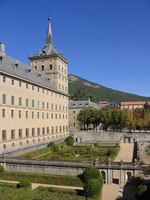
Philip II built a monastry combined with a royal palace, a tomb and a garden. It was a memorial to his father, Charles V, a symbol of his piety and a fulfillment of a vow, made after God granted him a victory over the French at Saint-Quentin in 1557. Juan de Bautista and Juan de Herrara were the designers. Philip II was cold, scholarly, diligent and deeply religious. He ruled the world's first empire 'on which the sun never set', mainly by writing letters in the privacy of his study. It embraced huge areas of Europe, the Americas and the South Pacific. Galleon-loads of South American gold were used to prosecute European wars and to carry out extensive building works. Renaissance palace-monast.....
Read more on Jardin del Monasterio de El Escorial